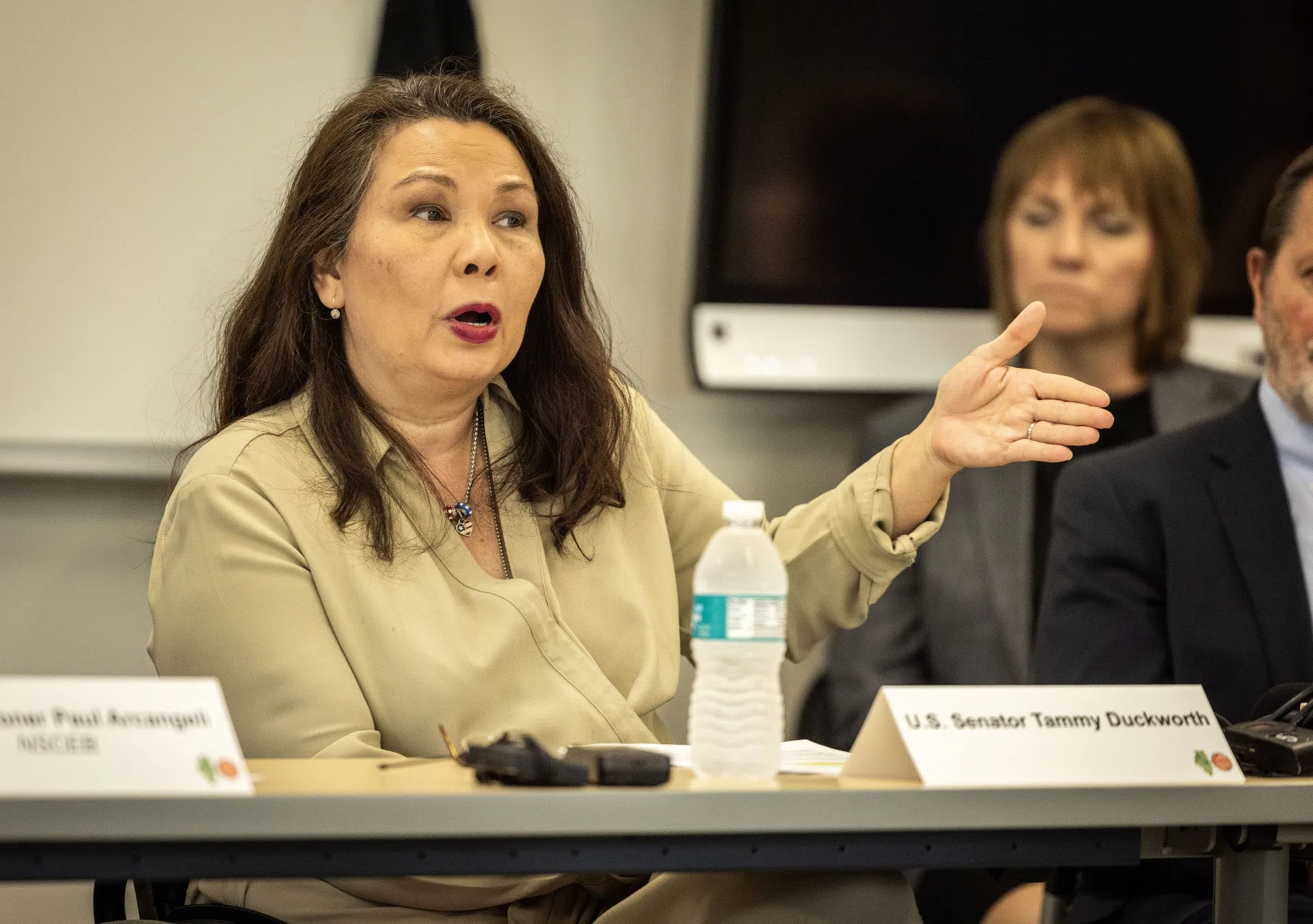
Democratic Sen. Tammy Duckworth leads discussion in the biotechnology race between China and the U.S. at the roundtable on UI’s campus Friday afternoon. Rob Le Cates/The News-Gazette
Sen. Duckworth: It’s imperative for U.S. tech to stay on American soil
By Rob Le Cates/The News-Gazette
URBANA — Leaders in national security, legislation, education and biotechnology met on the University of Illinois campus Friday afternoon, discussing the country’s prospective future and touring machinery that may enable the U.S. to pull ahead of the pack.
The National Security Commission on Emerging Biotechnology, formed two years ago, aims to maintain the United States’ domestic biotechnology lead against rapidly evolving China, which has prioritized biotech for the last 20 years. Congress also doesn’t want to grow reliant on American trade partners.
U.S. Sen. Tammy Duckworth, D-Ill., referenced solar panels: While pioneered in America, they mostly aren’t produced in the country. Having U.S. technology stay on U.S. soil is crucial, she said.
“We shouldn’t let that technology slip overseas where people can actually go to industries and make the money and have the jobs and be more competitive against Americans with things we invented here,” Duckworth said.
By investing in and best utilizing the domestic supply, the senator said, it allows manufacturers to maintain a solid customer base to keep production running. “I see this as an opportunity moving forward. I think we need to seize opportunities, whether it is new forms of fuel, energy source … or new forms of plastics for the future,” Duckworth said. “Whatever that is, I want us to be at the forefront of the supply chain with the capacity and capability to take advantage of that new technology when it’s developed.”

Members of the National Security Commission on Emerging Biotechnology tour the UI’s iFAB Tech Lab on Friday.
Rob Le Cates/The News-Gazette
In October 2023, the Economic Development Administration announced the Illinois Fermentation and Agricultural Biomanufacturing Tech Hub as one of 31 facilities around the country aimed at furthering cutting-edge biotech research.
NSC officials have spent the past summer visiting each of the facilities.
Locally, on Friday morning, they started at food processing and manufacturing sites ADM and Primient in Decatur, then visited EnterpriseWorks and the Integrated Bioprocessing Research Laboratory at the UI’s Urbana-Champaign campus before ending the day with the discussion and tour with Duckworth.
“We have to keep those people in business. We have to keep them innovative,” she said. “This is why iFAB is so critically important, and I’m so proud of it because it provides consistency, so that people can make those initial adjustments.”
At the start of their term, the commissioners realized how biotech influenced national security and reviewed how new advancements could shape and improve the country’s future.
Commissioner Paul Arcangeli said the team has made significant progress since releasing their report in April.
They pitched 49 recommendations, with around 25 taking shape in Congressional bills, urging the government to dedicate at least $15 billion to the biotechnology sector.
“The commission has another 16 months before we fold up our tent and go home. In those 16 months, we will continue to advocate for the remaining recommendations, and we will use that time to produce new recommendations based on these kinds of interactions,” Arcangeli said, referencing the forum and visits across the country.
iFAB Chief Strategy Officer Nicole Bateman said the tech hub was created to help companies work together seamlessly and allow companies to test their products through precision fermentation. This involves using corn dextrose, a corn byproduct, to create other useful materials like textiles, pigments, rubber, food proteins, biofuels and cosmetics.
This takes form as a region between Macon, Piatt and Champaign counties, each facility having different size-scaling assets allowing companies to test the viability of biotechnology.
The facility on the UI’s campus is one of the smaller sites, holding 1,500 liters. Soon Primient and ADM will build sites with 13,000 and 80,000 liters respectively.
Bateman said the partnership between the communities will help continue the facilities’ ground-breaking research, while boosting the economy.
“This is very new for Decatur to be partnering at this level with another community, specifically the University of Illinois and communities of Champaign-Urbana to create and advance an economy together,” she said. “We’re better together, and so that’s why we joined forces to create the iFAB Tech Hub.”
